EBOO Therapy Explained: What Ozone Blood Cleansing Really Involves
EBOO has become one of the more talked-about treatments in wellness medicine, yet most people hear the name long before they understand what it involves. EBOO stands for extracorporeal blood oxygenation and ozonation, a procedure in which a person's blood is circulated outside the body, exposed to oxygen and medical ozone, and then returned to circulation. It belongs to a wider family of oxidative therapies that have been used in parts of Europe for decades. Because EBOO is often marketed with strong language and modest evidence, it helps to separate what the procedure actually does from what it is claimed to do.
What EBOO therapy actually is
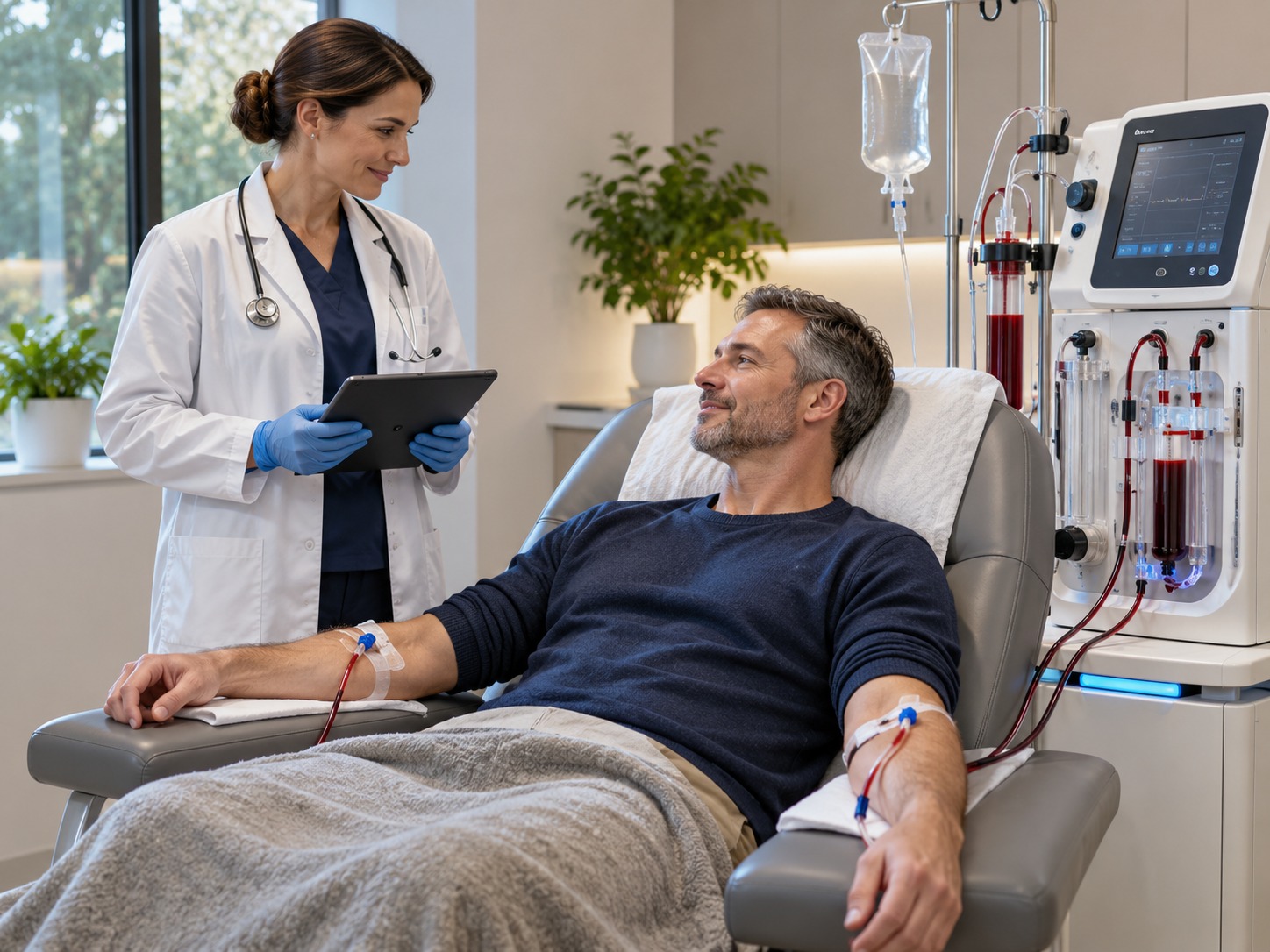
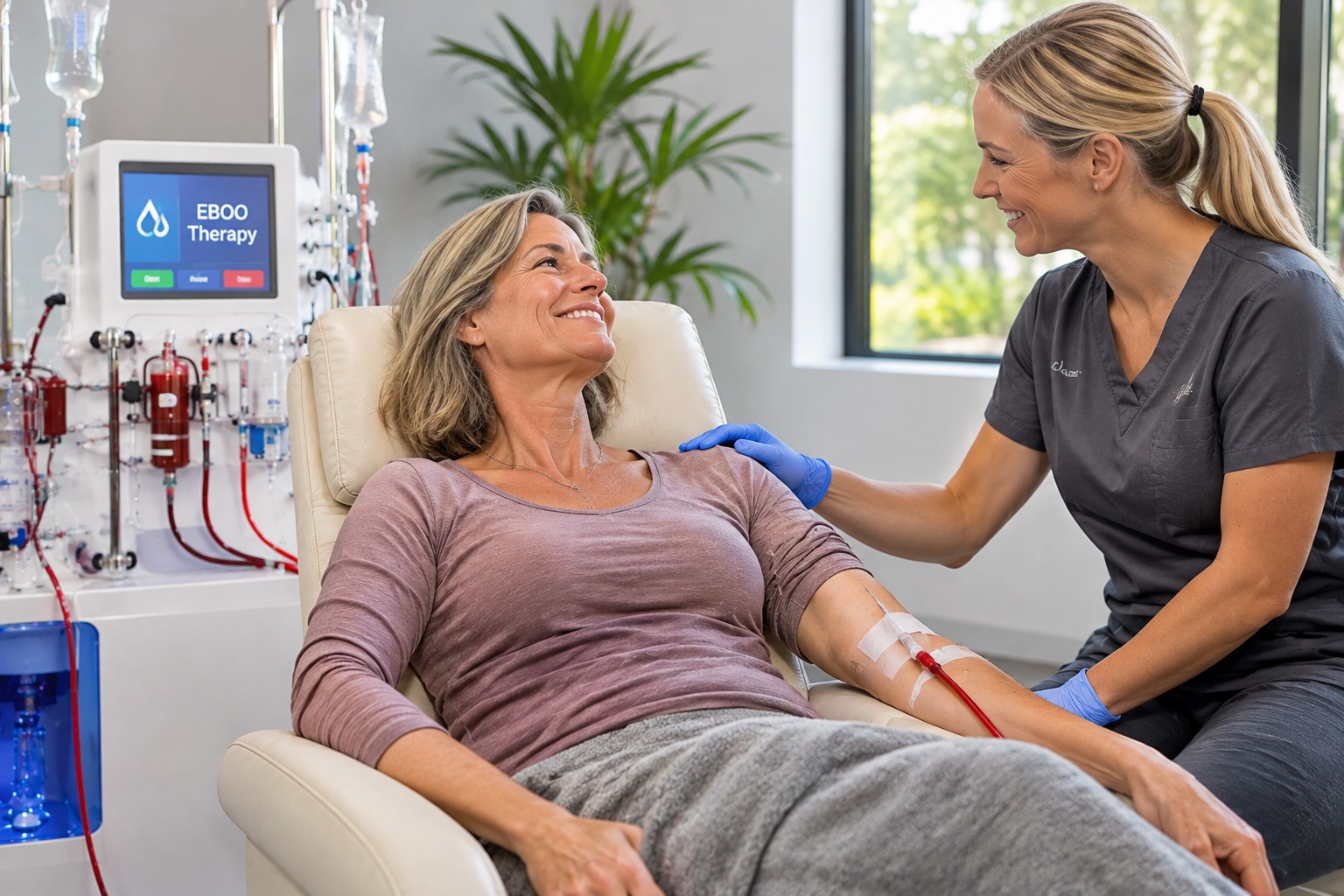
In a standard EBOO session, blood is drawn from one arm and passed through a sterile, single-use circuit. Inside that circuit the blood moves through a filter and a chamber where it meets a controlled mixture of oxygen and ozone gas. Many clinics add ultraviolet light during the same pass, a step known as ultraviolet blood irradiation, or UBI. The treated blood then returns to the body through the other arm, so the loop stays closed from start to finish. A full session usually takes around an hour, and the blood often takes on a brighter red color as its oxygen content rises.
The approach is sometimes described as ozone dialysis, though that label is loose. Unlike kidney dialysis, EBOO is not removing a defined waste product measured by a lab value. It is adding ozone and oxygen to blood on the theory that a brief oxidative signal prompts the body to respond. That difference matters, because it shapes how the results should be understood and how much weight the surrounding claims deserve.
EBOO combines ozone with UV light
Many EBOO sessions pair blood ozonation with ultraviolet blood irradiation, so the same pass through the circuit uses both a medical ozone and oxygen mixture and UV light. Both belong to a family of oxidative therapies that have a longer history of use in parts of Europe than in the United States.
Ozone is a three-atom oxygen molecule
Ozone is made of three oxygen atoms rather than the two in the oxygen we breathe, which makes it unstable and highly reactive. That reactivity is the reason it is handled at carefully controlled concentrations and the reason regulators classify the gas itself as toxic at higher exposures.
The blood stays in a closed loop
During EBOO the blood travels through sterile, single-use tubing and a filter and returns to the same person, so it never leaves a closed circuit. This design is why trained clinical staff, proper sterilization, and controlled technique are central to performing the procedure safely.
The theory behind oxidative therapy
Ozone is an unstable molecule made of three oxygen atoms. Inside the body it reacts quickly and creates a short burst of oxidative stress. Supporters argue that this controlled, low-level stress triggers a protective response, nudging cells to raise their own antioxidant defenses and improve how they use oxygen. The concept is a form of hormesis, the idea that a small dose of a stressor can prompt a helpful adaptation. Laboratory work shows that ozone can affect red blood cells, immune signaling, and circulation.
It is worth being honest about the gap between a plausible mechanism and a reliable result. A mechanism that holds up in a test tube or a small study does not always translate into a meaningful benefit for a specific condition in a living person. Much of the enthusiasm for EBOO rests on early research, clinical experience, and patient reports rather than large, well-designed trials, and that distinction should stay in view throughout any decision about the therapy.
What people use EBOO for
Clinics that offer EBOO therapy commonly describe it as support for ongoing fatigue, lingering inflammation, recurrent infections, circulation concerns, and general recovery or wellness. Some people pursue it as part of a broader plan for complex, hard-to-treat conditions after conventional options have fallen short. Others try it simply hoping for steadier energy. The reasons people give tend to cluster around a handful of themes.
Ongoing fatigue and low energy
Chronic or low-grade inflammation
Recurrent or long-standing infections
Circulation and oxygenation concerns
General recovery and wellness support
None of these uses should be read as a promise. EBOO has not been shown to cure or reverse any specific disease, and careful practitioners present it as a supportive option rather than a solution. A person with a diagnosed medical condition is wise to treat EBOO as a possible complement to standard care, discussed openly with their own physician, not as a replacement for treatment that already has strong evidence behind it.
Evidence and regulatory status
This is where candor matters most. In the United States, EBOO and ozone therapy are not approved by the Food and Drug Administration for the treatment of any medical condition. The FDA has long classified ozone as a toxic gas and has stated that, in order to act as a therapy, ozone would need to be present at levels that could be harmful, concluding that it has no generally recognized useful medical application in supportive or preventive terms. Clinics that provide EBOO do so as an off-label wellness service.
That regulatory position does not automatically make the therapy worthless, but it does mean the evidence has not met the bar required for approval. A growing number of small studies and review papers examine ozone's effects, and the therapy has a long record of use abroad, yet large, high-quality clinical trials remain limited. Anyone weighing EBOO deserves to hear that limitation said plainly rather than buried beneath marketing language.
Safety and who should be careful
Safety depends heavily on technique. Because EBOO involves drawing and returning blood, sterile single-use equipment, trained medical staff, and correct ozone concentrations are not optional. Any procedure that handles blood carries a risk of infection or air embolism if done carelessly. Performed properly in a clinical setting, reported side effects are usually mild, such as temporary tiredness, lightheadedness, or soreness at the needle site. The therapy is also not suitable for everyone.
G6PD deficiency, a red-blood-cell condition
Pregnancy
Active bleeding disorders
Uncontrolled hyperthyroidism
Recent heart events or unstable heart disease
A thorough health history, and in many cases blood work, should come before any session. People with the conditions above are generally advised to avoid ozone therapy, which is one reason the procedure belongs with licensed medical providers rather than in unsupervised settings. Honest screening protects patients and is a reasonable thing to expect from any clinic offering the service.
How to weigh a provider and a decision
Because the field is loosely regulated, the quality of the provider carries much of the weight. Reasonable questions include who performs the procedure and what their medical training is, how equipment is sterilized, what ozone concentrations are used, and what screening happens beforehand. Clinics and functional-medicine resources such as www.bodyrejuvenationmd.com publish descriptions of how they approach oxidative therapies, and comparing several sources helps a person tell measured information from overstated promises.
What a session is like
For a person trying EBOO for the first time, the experience resembles a long blood draw combined with an infusion. A provider places a line in each arm, the blood circulates through the machine for the better part of an hour, and the person sits or reclines throughout. Most clinics monitor comfort and vital signs during the session. Afterward, some people feel tired or slightly flushed for a day, while others notice little. Clinics usually advise drinking water, resting, and avoiding strenuous activity for the rest of the day. Because the procedure moves a volume of blood through the circuit, it is not advised for people who are dehydrated, anemic, or unwell on the day of treatment.
Aftereffects vary from person to person, and the lack of large studies means there is no reliable schedule of how many sessions produce a given result. Some clinics recommend a series; others offer single sessions. A person is wise to treat any proposed course as a trial with an agreed point to reassess, rather than an open-ended commitment, and to keep their regular physician informed, especially if they take medications or manage a chronic condition.
How EBOO differs from other ozone methods
Ozone has been used medically in several forms, and EBOO is one of the more involved. Simpler approaches include major autohemotherapy, where a smaller amount of blood is withdrawn, mixed with ozone, and reinfused, along with rectal or topical ozone for specific uses. The therapy here is set apart by its continuous, filtered, higher-volume circuit, which is why it is marketed as a more thorough version. Whether that added intensity produces a better outcome is not established, and more is not automatically better when the active ingredient is an oxidative stressor. Understanding which method a clinic actually offers, and at what concentration, is part of making an informed choice.
A note on cost and marketing
The procedure is usually an out-of-pocket expense, and prices vary widely between clinics, which adds a practical dimension to the decision. Because the therapy is marketed heavily while the evidence stays thin, a person can reasonably ask whether the money is better spent on interventions with stronger support for their particular concern. That is not an argument that it is useless, only that it should compete honestly for a place in a health budget rather than being presented as a must-have. It also helps to remember that feeling better after any involved, attentive procedure can owe something to rest, hydration, and expectation, which is one more reason measured claims and honest tracking matter.
EBOO therapy sits in an honest middle ground. It is neither the miracle that some advertising suggests nor plainly useless. It is an oxidative therapy with a reasonable theoretical basis, a long history of use in some countries, limited high-quality evidence, a real need for careful technique, and no FDA approval for treating disease. The information here is educational and is not a substitute for professional medical advice, diagnosis, or treatment, and anyone considering EBOO should review their own health history with a licensed provider. Approached with clear eyes and honest expectations, a person can judge EBOO the way they would any emerging therapy, on the strength of the evidence and the quality of the care rather than the volume of the claims.
The city is known as the home of Gulfstream Park (horse racing and casino) and Big Easy Casino, which hosts the World Classic. It also has a sizable downtown financial district with banks, brokerage houses, and restaurants. Together with neighbouring Hollywood, Florida, it is a popular center for Canadian tourists,[10] leading to its description as "Canada's southernmost city."[1][2]
View from Hallandale Beach Apartments (January 2019)
Railroad magnate Henry Flagler, owner of the Florida East Coast Railway, recruited Luther Halland, a brother-in-law of Flagler's agents, to found a settlement south of the community of Dania. Halland and Swedish immigrant Olaf Zetterlund touted the frost-free climate and cheap land of the settlement (then named Halland, later changed to Hallandale). Halland constructed a small trading post and became the first postmaster of the small community.
By 1900, the community had slowly grown to a dozen families—seven of Swedish, three of English, and two of African American descent. In 1904, the first school was built, and the first church followed two years later. Hallandale was primarily a farming community.
Hallandale was incorporated on May 14, 1927, the eighth municipality in Broward County. By that time, a thriving community of 1,500 residents, with electricity and street lights, was in place. In 1947, the Town of Hallandale was reincorporated as the City of Hallandale, allowing it to expand its borders through annexation of nearby unincorporated land lying adjacent to the Atlantic shore. On August 27, 1999, the city officially changed its name to Hallandale Beach.[5]
According to the United States Census Bureau, the city has a total area 4.55 square miles (12 km2). of which .34 sq mi (1 km2) (7.47%) is covered by water.
Although a map apparently shows that a small portion of the Golden Isles neighborhood extends into Miami-Dade County, this land was actually transferred to Broward County, and annexed to Hallandale Beach in 1978.[11]
As of the 2020 census, Hallandale Beach had a population of 41,217. The median age was 46.9 years. 16.0% of residents were under the age of 18 and 24.4% of residents were 65 years of age or older. For every 100 females there were 89.3 males, and for every 100 females age 18 and over there were 87.4 males age 18 and over.[16][17]
100.0% of residents lived in urban areas, while 0.0% lived in rural areas.[18]
There were 19,512 households in Hallandale Beach, of which 20.8% had children under the age of 18 living in them. Of all households, 34.5% were married-couple households, 23.6% were households with a male householder and no spouse or partner present, and 35.5% were households with a female householder and no spouse or partner present. About 38.5% of all households were made up of individuals and 17.8% had someone living alone who was 65 years of age or older.[16] There were 9,135 families residing in the city.[19]
There were 28,443 housing units, of which 31.4% were vacant. The homeowner vacancy rate was 2.0% and the rental vacancy rate was 10.0%.[16]
As of the 2000 census, of the 18,051 households, 12.5% had children under 18 living with them, 35.8% were married couples living together, 9.1% had a female householder with no husband present, and 51.8% were not families. About 45.2% of all households were made up of individuals, and 25.8% had someone living alone who was 65 or older. The average household size was 1.88 and the average family size was 2.60.
In 2000, in the city, the age distribution was 13.2% under 18, 5.3% from 18 to 24, 22.9% from 25 to 44, 22.8% from 45 to 64, and 35.8% who were 65 or older. The median age was 53 years. For every 100 females, there were 85.6 males. For every 100 females 18 and over, there were 82.6 males.
In 2000, the median income for a household in the city was $28,266, and for a family was $37,171. Males had a median income of $31,287 versus $24,882 for females. The per capita income for the city was $22,464. About 13.1% of families and 16.8% of the population were below the poverty line, including 26.4% of those under 18 and 13.0% of those 65 or over.
In almost all areas, elementary and middle school students are zoned for Gulfstream Academy of Hallandale Beach for kindergarten to grade 8.[24] A portion of the city is zoned to Colbert Elementary School and McNicol Middle School.[25][26] In all areas, high school students are zoned for Hallandale High School.[27] Private academies eschewing the public system are present in the area. [citation needed]
A free community minibus service, operated by the city of Hallandale Beach, also operates on four routes within the city limits and neighboring areas of Hollywood and Aventura.[31]
^"Top 50 TV markets ranked by households". Northwestern University Media Management Center. Archived from the original on August 7, 2007. Retrieved September 23, 2007.
EBOO stands for extracorporeal blood oxygenation and ozonation. It is a procedure in which blood is drawn, passed through a sterile closed circuit where it is filtered and exposed to a medical ozone and oxygen mixture, often along with ultraviolet light, and then returned to the body. It is offered as a wellness therapy and is not approved to treat any specific disease.
Is EBOO ozone therapy approved by the FDA?
No. In the United States the FDA has not approved EBOO or ozone therapy for treating any medical condition, and it classifies ozone as a toxic gas. Clinics that provide EBOO do so as an off-label wellness service. The research that exists is mostly small or preliminary, so the therapy should be approached as emerging rather than established.
Is EBOO therapy safe, and who should avoid it?
When performed by trained medical staff with sterile single-use equipment, reported side effects are usually mild, such as temporary fatigue or soreness. Even so, it is not for everyone. People who are pregnant, have G6PD deficiency, bleeding disorders, uncontrolled hyperthyroidism, or recent heart problems are generally advised to avoid it. A health review should always come first.